Our Verdict
Pros
- Vastly improved design.
- Excellent build quality.
- Small form factor.
- Improved performance is a big step up over older wheel bases.
- Very competitively priced.
- Excellent array of direct connection ports.
Cons
- Tricky to side mount to some sim rigs and cockpits.
- Design looks familiar to other brands.
- Pit House can get confusing to set up.
- RGB lighting isn’t a game-changing feature and can look tacky.
MOZA has been killing it in the budget and midrange sim racing space for years now. Their R16 and R21 wheel bases have been solid wheel bases, but they’re starting to show their age. Enter the R21 Ultra and R25 Ultra, two completely redesigned wheel bases that look ready to take on the big boys like Asetek, Fanatec, and Simucube.
These aren’t just minor updates either. MOZA went back to the drawing board with brand new motors featuring zero cogging technology, aluminium casings, and yes, RGB lights. But the real question is whether all these upgrades actually make a difference when you’re racing. I’ve spent the last month putting the R21 Ultra through its paces to find out.
Watch our MOZA R21 Ultra direct drive wheel Review
What Makes These Wheel Bases Special?
Everything about these new Ultra models is different from what came before. The internal motor is entirely new, built around a flat wire design that eliminates cogging. If you’re not familiar with cogging, it’s that annoying feeling where wheel bases sort of jump in 5 to 10 degree intervals instead of rotating smoothly. The new motor design gets rid of that completely, giving you buttery smooth rotation and way better accuracy.
MOZA is now matching competitors with sustained torque output of 21Nm or 25Nm depending on which model you choose. That means less power degradation during long race sessions. You also get a 21 bit magnetic encoder and MOZA’s latest force feedback algorithm working behind the scenes.

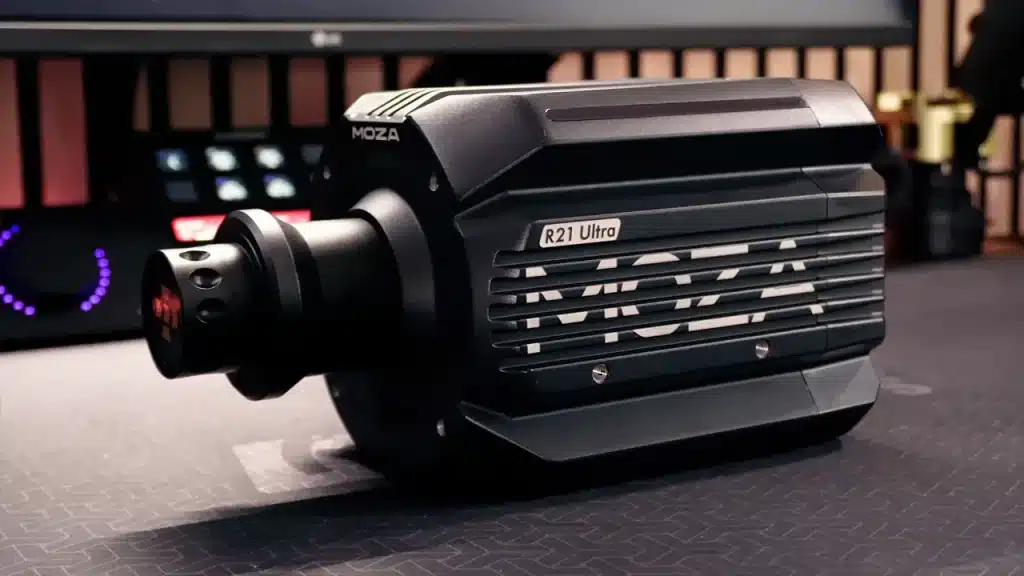
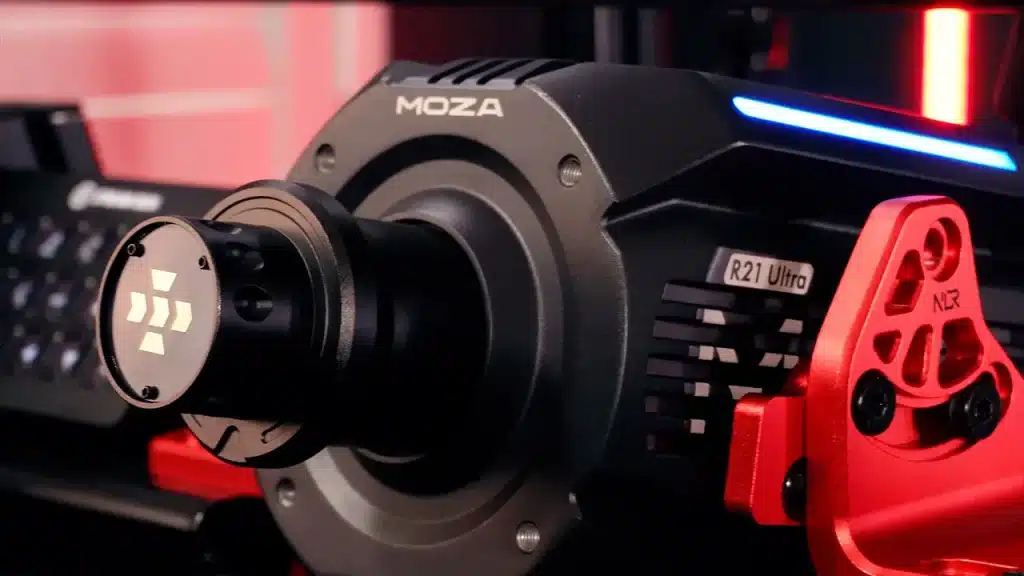
The exterior got a total makeover too. The CNC machined aluminium casing looks premium and feels solid, which matters when you’re dealing with this much torque. And those RGB light strips across the top corners? They’re basically taking a page from Asetek’s playbook, but the implementation is actually pretty slick. You can configure them to flash based on telemetry data, which is a nice touch.
Pricing That Actually Makes Sense
The R21 Ultra costs $699, while the R25 Ultra is $899. When you consider that the old R21 from 2021 sold for $849 right up until it was discontinued, you’re actually saving $150 by upgrading to the new R21 Ultra. Want the beefier R25 Ultra instead? That’s only $50 more than what the old R21 cost.
Let me put this in perspective. A 15Nm Fanatec wheel base will run you almost $1180. A Simucube 2 Pro costs $1449. MOZA is coming in under $1000 for both models and delivering competitive specs. That’s aggressive pricing that should have other brands paying attention.
| Product | Price |
|---|---|
| MOZA R21 Ultra DD wheel base | UK: £699 EU: €799 US: $699 |
| MOZA R25 Ultra DD wheel base | UK: £899 EU: €999 US: $899 |

First Impressions
If you’ve bought MOZA gear before, the packaging won’t surprise you. You get the usual stickers, paper manual, power brick, and USB cable, all packed nicely in foam cutouts. There’s mounting hardware included, and the wheel base itself comes in a protective dust bag. Fair warning though, this thing is heavy.
The design
The new design is immediately obvious. The grooves running down the sides and across the top are evolved versions of what you see on MOZA’s smaller bases like the R12. Then there are these haunches in each corner that honestly look a lot like what Fanatec does with their Clubsport DD bases. Strip away the branding and you could easily mistake this for a Fanatec product. I’m not saying MOZA copied anyone, but the similarities are definitely there.
Build quality is excellent across the board. The CNC machined aluminium housing isn’t just for show either. It keeps everything rigid when you’re running high torque, and it definitely helps justify the price tag when your wheel base looks and feels this premium.
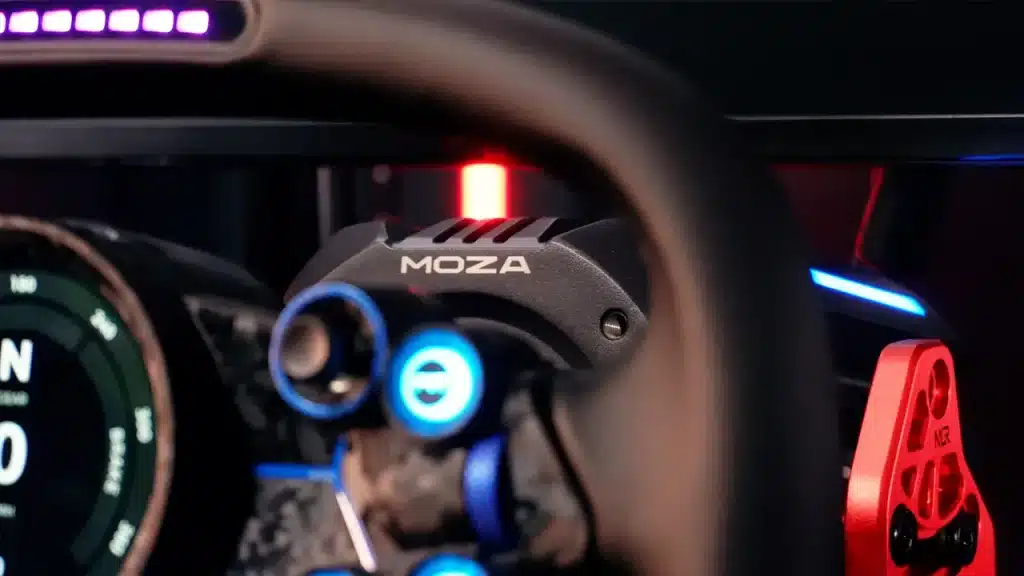
Those RGB Lights
The LED light strips are new territory for MOZA, though Asetek pioneered this years ago, followed by Thrustmaster and SIMAGIC. While RGB lighting isn’t something I’d personally prioritize when buying a wheel base, MOZA’s implementation is better than recent attempts from other manufacturers. Both Thrustmaster and SIMAGIC kind of hide their lights behind the steering wheel, but MOZA displays them proudly across the top and sides, just like Asetek does.
The fact that you can configure them to work as live telemetry is a nice bonus. Not essential, but cool if you’re into that sort of thing.

Connectivity Options
A wheel base is basically the hub of your sim racing setup, so connectivity matters. If you go all in on the MOZA ecosystem with their pedals, shifters, and other accessories, you’ll appreciate the ports on the back. There are connections for pedals, dashboards, shifters, and accessories like the E-Stop. This lets you clean up your cabling significantly and reduces the number of USB connections running to your PC. The base essentially acts as its own USB hub, which is genuinely convenient.
The quick release up front is mostly unchanged from previous generations. It supports wireless connectivity and power delivery to all current MOZA steering wheels. I’ve covered this in previous MOZA reviews, but the mechanism and ease of use remain fantastic.

Mounting Headaches
One area where MOZA has improved things is mounting flexibility. Previous generations only offered front and bottom mounting, but the Ultra models add side mounting options. This is great in theory, and I personally prefer side or front mounting when possible.
Here’s where I ran into my first real problem though. While having side mounts is nice, they’re going to require MOZA specific brackets to work properly. I tested this with both a Sim Lab and Next Level Racing rig, both of which support side and front mounting. Neither rig natively fit the mounting profile of the R21 Ultra.
I managed to force the Next Level Racing side mounts into the predrilled MOZA holes, but it turns out those holes are about 5mm too close together to naturally fit my NLR bracket. After using way more force than I should have, I got it mounted with small gaps on either side. It’s been secure through a month of testing without anything breaking or coming loose, but it’s definitely not ideal and feels a bit sketchy.

How It Performs On Track
Once I got the thing mounted (just barely!), it was time to see how it actually performs. I have both the R21 Ultra and R25 Ultra here, which put out a maximum of 21Nm and 25Nm of peak torque respectively.
These aren’t quite at the insane levels of a Simucube 2 Ultimate or Asetek Invicta, but they’re plenty strong. Despite my questionable mounting situation, I decided to go all in and jump into Le Mans Ultimate with the force feedback maxed out.
My mounting held up, and I immediately understood what all the hype was about. This is an incredibly smooth wheel to race with. MOZA’s zero cogging technology is legit. You can feel it during racing, or rather, you can’t feel the cogging and choppiness that plagued older bases, which is exactly the point.
Throwing the car through corners in Assetto Corsa Competizione, you feel the weight build naturally in the wheel as the car’s balance shifts. With 21Nm of peak torque from the R21 Ultra, there’s still plenty of strength when you clip a kerb. Depending on your max strength setting, kerb strikes can be pretty jarring, especially if you’re running the base at full torque. A solid kerb hit will echo through your entire rig, vibrating the chassis and seat.
More subtle rumbles and track details come through clearly too. It almost feels like there’s an underlying haptic motor module positioned throughout your cockpit. This really pushes the immersion factor and helps you feel what the car is doing.
The responsiveness is impressive as well. The R25 Ultra gets exclusive access to real time torque sensing with a response frequency up to 2kHz. As far as I know, this tech isn’t on the R21 Ultra that I’m testing, but that doesn’t take away from what is a lightning fast response time.

During use, there’s virtually no noise at all. The steering wheel rotation is silent, and if you mute your game audio, you can barely hear the internal motor even when the force feedback cranks up. The only sounds you’ll notice are the vibrations from kerbs and other rumbles transmitting through the rig.
Heat management is also excellent. After a couple hours of racing, the outer casing was only slightly warm. MOZA integrated a solid thermal management system that monitors and regulates heat in real time, and it shows during long race sessions.
The Software Experience
Customization happens through MOZA’s Pit House software, which is free and gives you an almost overwhelming amount of control. You can adjust practically every aspect of your wheel, from overall strength to damping at different speeds to various filters. For tinkerers, this level of granular control is fantastic.
For sim racers who’d rather spend time on track than in menus though, all these sliders can feel overwhelming. Thankfully there’s a preset manager that lets you load official presets created for specific games, which helps a lot.
Pit House has always been one of the more in depth sim racing software packages, for better and worse. I’m not knocking all the options MOZA provides, but after using Pit House for years, I do wish some settings were explained and laid out more clearly.
Final Verdict
This is actually a pretty significant moment in sim racing. While brands like Fanatec have been raising their prices and pushing premium wheel bases further out of reach for many sim racers, MOZA has done the opposite. They’re actively lowering that barrier to entry.
Having a 25Nm direct drive wheel available for under $1000 from a major brand is huge. MOZA dominated the budget and midrange markets, and now they’re applying the same strategy to the premium space.
The improved design, solid build quality, and excellent performance let the R21 and R25 Ultra compete with the big names when discussing premium wheel bases. There’s still some refinement needed before these can truly challenge Simucube’s dominance at the very top of the market.
But these wheel bases absolutely deliver on the promise of feeling next generation. The performance improvements are real and noticeable. If you’re looking to upgrade to a high powered direct drive wheel base, both the R21 Ultra and R25 Ultra deserve serious consideration.
Frequently asked questions
The R25 Ultra is a major step up from older MOZA bases in terms of force feedback feel. Pure performance doesn’t quite match the Simucube 2 Pro, but the price difference is substantial, making the R25 Ultra a very attractive option.
Both Ultra models have been available since October 2025 on the MOZA Racing website.
Unfortunately no. Both the R21 Ultra and R25 Ultra are PC only.
Technical Specifications
Review written by Felix König